
How to Make Perfume at Home: Complete Beginner's Guide with Recipe
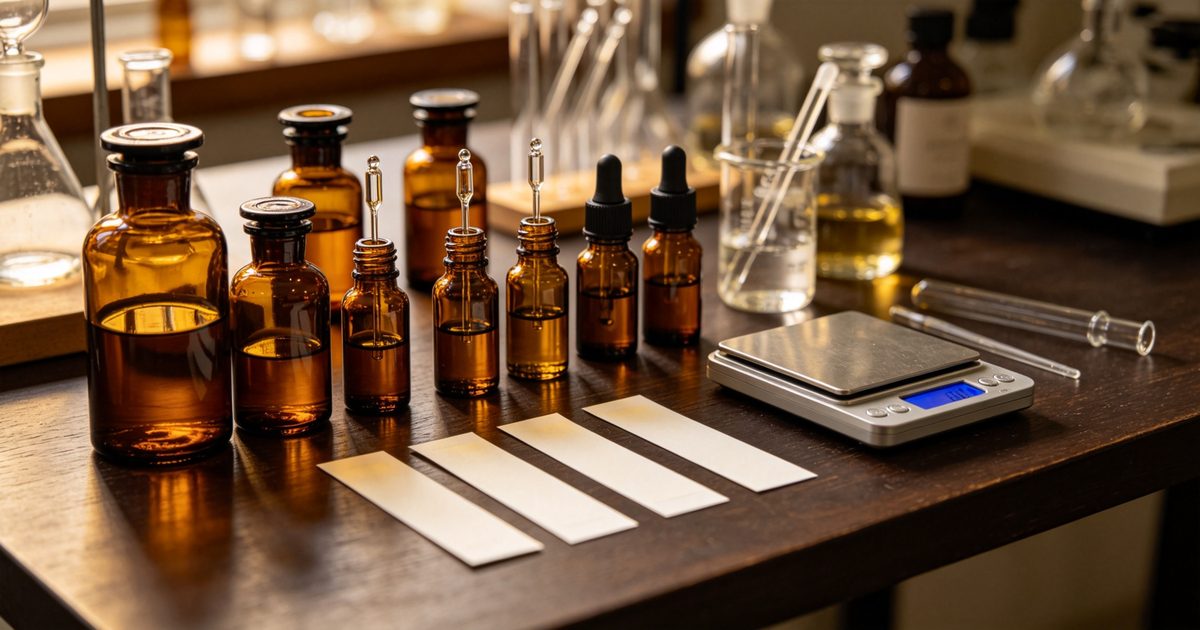
Making perfume at home is less mysterious than the fragrance industry wants you to believe. At its core, a spray perfume is three things: fragrant materials, a solvent, and time. You do not need a chemistry degree or a professional organ — you need a handful of quality oils, a bottle of perfumer's alcohol, a scale or a steady hand with a dropper, and the patience to let the blend mature.
This guide walks you through the whole process the way a junior perfumer would learn it: how concentration actually works, how to think in top, middle, and base notes, a complete drop-by-drop beginner recipe you can make tonight, and the safety rules that keep DIY perfumery fun instead of itchy.
What You Need to Get Started
You can start for the price of a couple of takeaway dinners. Here is the realistic minimum kit:
- Fragrance oils, essential oils, or both. Fragrance oils are cheaper, more stable, and more forgiving for beginners; essential oils smell more "natural" but behave less predictably. Five to eight materials is plenty for your first experiments.
- Perfumer's alcohol. High-proof neutral ethanol (often sold as perfumer's alcohol or SDA 40B where legal). This is the carrier that lets the scent spray and project.
- A 0.01 g digital scale (preferred) or graduated pipettes and a consistent dropper. Professional formulas are written in grams; drops are fine for learning.
- Dark glass bottles — 10 ml rollerballs or 30 ml atomizers — plus blotter strips (or plain coffee-filter paper cut into strips) for evaluation.
- A notebook. This is non-negotiable. Write down every drop. The difference between a hobbyist and a formulator is that the formulator can repeat what worked.
If you need to stock up, our guide to fragrance oil suppliers covers beginner-friendly vendors that sell small bottles with proper documentation.
Understanding Perfume Concentrations
Concentration is simply how much of your final bottle is fragrant material versus alcohol. It controls strength, longevity, and price. The standard industry tiers:
- Eau fraîche: 1–3% fragrance — a light body-mist feel, gone in an hour or two.
- Eau de cologne (EDC): 2–5% — fresh, traditional, short-lived.
- Eau de toilette (EDT): 8–15% — the sweet spot for beginners. Noticeable but not overwhelming, forgiving of formula mistakes.
- Eau de parfum (EDP): 15–20% — richer and longer-lasting; demands a better-balanced formula because flaws are amplified.
- Parfum / extrait: 20–30%+ — dense and intimate; usually dabbed, not sprayed.
The math is simple. For a 30 ml EDT at 10% concentration, you need 3 ml (about 3 g) of fragrance concentrate and 27 ml of alcohol. Make the concentrate first, evaluate it, then dilute. Never blend your experiment directly in the final alcohol volume — you will want to adjust the concentrate without wasting solvent.
Thinking in Top, Middle, and Base Notes
A perfume is built like a piece of music: some materials arrive first and leave quickly, some form the main melody, and some linger for hours after everything else is gone.
Top notes (first 5–15 minutes)
Small, volatile molecules: citrus (bergamot, lemon, grapefruit), light herbs, aldehydes. They create the first impression and sell the perfume, but they evaporate fast. Typical share of a beginner formula: 15–25%. See our bergamot profile for why this citrus is the backbone of countless classics.
Middle (heart) notes (15 minutes–3 hours)
The character of the scent: florals (jasmine, rose, lavender), spices, green notes, tea accords. They bridge the bright opening and the deep drydown. Typical share: 30–50%.
Base notes (3 hours and beyond)
Heavy, slow materials: woods (sandalwood, cedarwood), musks, vanilla and vanillin, resins, amber accords like Ambroxan. Base notes provide longevity and act as fixatives that hold the lighter notes on skin. Typical share: 15–25% — and skimping here is the number-one reason homemade perfumes vanish in an hour.
Single aroma chemicals can play these roles too. A trace of Hedione, for example, adds a transparent jasmine-like radiance that lifts an entire heart accord.
Your First Recipe: A Clean Citrus-Wood EDT
This 10 ml concentrate makes a fresh, unisex eau de toilette once diluted. It uses beginner-friendly, widely available fragrance oils. Work at roughly 20 drops per ml if you lack a scale, and write everything down.
- Bergamot fragrance oil — 40 drops (top: bright, sparkling opening)
- Lavender fragrance oil — 30 drops (heart: clean, herbal-floral)
- Green tea fragrance oil — 20 drops (heart: airy, modern freshness)
- Cedarwood fragrance oil — 30 drops (base: dry pencil-wood structure)
- White musk fragrance oil — 40 drops (base: skin-like softness and fixation)
- Vanilla or vanillin blend — 10 drops (base: rounds off sharp edges)
That is 170 drops ≈ 8.5 ml of concentrate; top the bottle with a little alcohol to 10 ml if you want a round number. Then dilute: combine your 10 ml concentrate with 90 ml of perfumer's alcohol for a ~10% EDT (yields about 100 ml), or with 57 ml of alcohol for a ~15% strong EDT.
Blend the concentrate in this order — base notes first, then heart, then top — cap it, shake gently, and let it rest. The blend will smell harsh and disjointed on day one. That is normal.
Maturation: Why Waiting Makes It Better
Fresh blends smell like separate ingredients sitting in the same room. Given time, molecules interact, sharp alcohol edges soften, and the scent fuses into one coherent impression. The practical timeline:
- 48 hours: minimum rest before you evaluate the concentrate. Anything judged earlier will mislead you.
- 1–2 weeks: most EDTs smooth out noticeably; citrus-heavy blends integrate.
- 4–6 weeks: full maturation, especially for blends with vanilla, resins, or heavy musks.
Store the bottle tightly closed in a cool, dark place — a closet beats a sunny windowsill every time. Evaluate on blotter strips first, then on skin, and only after maturation decide what to adjust. Change one variable per iteration and note it.
Safety Basics Every Home Perfumer Should Follow
Perfumery is safe when you respect the materials. The International Fragrance Association (IFRA) publishes standards that assign every fragrance material usage limits by product category — leave-on skin products (like perfume) sit in a stricter category than, say, candles or rinse-off soap. You do not need to memorize the tables, but you should follow the general principles:
- Patch test every new blend. Apply a small amount to the inner forearm and wait 24 hours before wearing it broadly. Redness or itching means reformulate at lower concentration.
- Respect dilution. Essential oils and aroma chemicals are designed to be used diluted. A citrus oil that is pleasant at 5% of a formula can irritate skin applied neat — and some citrus oils are phototoxic in leave-on products above certain levels.
- Request documentation. Reputable suppliers provide IFRA conformity certificates and safety data sheets for their oils. If a vendor cannot provide them, buy elsewhere — our supplier guide explains exactly what paperwork to ask for.
- Special caution groups. Pregnant or nursing people, young children, and pets are more sensitive to many fragrance materials. Keep concentrations conservative, skip known problem materials, and consult a medical professional if in doubt. Never apply homemade blends to pets.
- Label and store safely. Perfume alcohol is flammable; keep it away from flames, and store finished blends away from heat, light, and curious children.
None of this is meant to scare you — millions of hobbyists blend safely. It is meant to build the habits that separate careful crafters from careless ones.
Frequently Asked Questions
How long does homemade perfume need to age?
Plan on a minimum of 48 hours for the blend to marry, but two to four weeks in a cool, dark place is where the real improvement happens. Many hobbyists find that a perfume judged after one week smells noticeably rougher than the same formula at one month.
What alcohol should I use for homemade perfume?
Use high-proof, neutral, undenatured ethanol — sold as perfumer's alcohol or SDA 40B where regulations allow. Do not use rubbing (isopropyl) alcohol; it has a strong medicinal odor and is not intended for skin fragrance. High-proof grain vodka works in a pinch but carries extra water that can cloud the blend.
Can I make perfume with only essential oils?
Yes, but expect a simpler, more naturalistic scent that fades faster than one built with aroma chemicals. A 100% essential-oil eau de toilette is a great learning project — just respect that natural materials also carry allergens and IFRA restrictions, so dilution and patch testing still apply.
Why does my homemade perfume disappear after an hour?
The most common causes are too few base notes, too low a total concentration, or no fixative. Raise your base-note share toward 20% of the formula, increase the total fragrance load toward 10-15%, and consider adding a fixative such as benzoin, labdanum, or a synthetic musk.
The Bottom Line
Your first perfume will not smell like a niche house release — and it does not need to. It needs to teach you how materials behave, how notes unfold, and how time transforms a blend. Make the recipe above, age it properly, and take notes. Your third or fourth iteration is where things start to smell genuinely good.
Ready for the next step? Learn where to source quality materials in our fragrance oil supplier guide, or see how a signature scent can become a business in how to start a perfume line on a small budget.
Related Articles
This post may contain affiliate links. If you click and buy, we may earn a small commission at no extra cost to you.